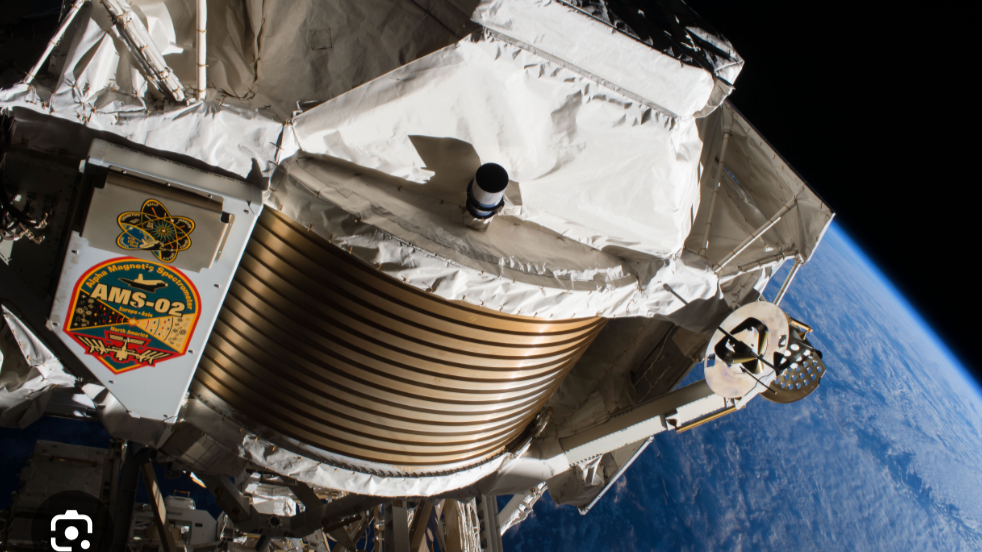
High-energy particle spectrometers are harder to build than simple monitors. Flux drops with energy, so useful measurements require enough sensitive area, enough detector depth, and enough onboard logic to separate signal from background.
At higher energies, penetrating particles and off-axis contamination become a serious instrument-design problem. In practice, that pushed many missions toward threshold detectors, coarse energy channels, or highly specialized research instruments rather than compact, deployable spectrometers that operators could actually fly as part of routine spacecraft architecture.
That tradeoff shaped the market for years.
Most operators were not buying full particle spectra. They were buying margins. Basic alerts. Radiation flags. Post-factum anomaly context. Government systems covered part of the need, but mostly through sparse assets, distant vantage points, and products that were never designed around dense, real-time, localized sensing in LEO. The result is a monitoring stack that still has major blind spots where the operational risk is growing fastest.
Low Earth orbit sits deep inside the magnetosphere, where local conditions can diverge sharply from what global indices or distant monitors suggest.Current operational approaches still depend heavily on L1 and GEO observations, global proxies such as Kp, Dst, and F10.7, and data pipelines that often translate into forecast and update cycles measured in hours rather than seconds or minutes.
Meanwhile, the most dynamic operational effects in LEO—particle precipitation, charging, drag shifts, localized environmental changes—do not wait on six- or twelve-hour refresh cycles.
The density side has the same problem from another angle. During Solar Cycle 25, thermospheric density rose well above earlier expectations, and operators felt that through higher drag and faster orbital decay.
Yet direct, distributed in-situ density truth remains sparse, while operational models still rely heavily on assimilative and statistical methods. This mismatch between proxy-driven modeling and direct local measurement is now one of the main operational constraints in LEO.
Some of the most operationally relevant signatures in LEO are carried by particles energetic enough to penetrate into orbital environments that many models treat too coarsely.
Polar access points, radiation-belt dynamics, solar energetic particle penetration, and local magnetospheric structure are still under-sensed from the places where spacecrafts fly. You cannot build serious anomaly attribution, better radiation nowcasting, or better localized forecasting from averages alone.
Our PL-series is built around that exact problem.
PL-1 is a silicon telescope line for medium-to-high-energy charged particles. Depending on the variant, it covers electrons roughly from 0.06 or 0.1 MeV up to 10 MeV and protons from 1 MeV up to 250 MeV. PL-2 is a Cherenkov detector for relativistic particles, with sensitivity above 5 MeV for electrons and above 450 MeV for protons. It is a modular hardware line designed to cover the particle environment from mid-energy populations through relativistic regimes, in a form factor that can be integrated on commercial spacecraft.
Historically, the industry had instruments at one of two extremes: either large research-class payloads with limited deployability, or simplified operational monitors that were easier to fly but did not provide the spectral richness, directionality, or flexibility needed for modern operational workflows. We at Mission Space are pushing on the middle ground that the market has lacked: instruments compact enough for hosted payloads and small satellites, but capable enough to support actual space weather operations.
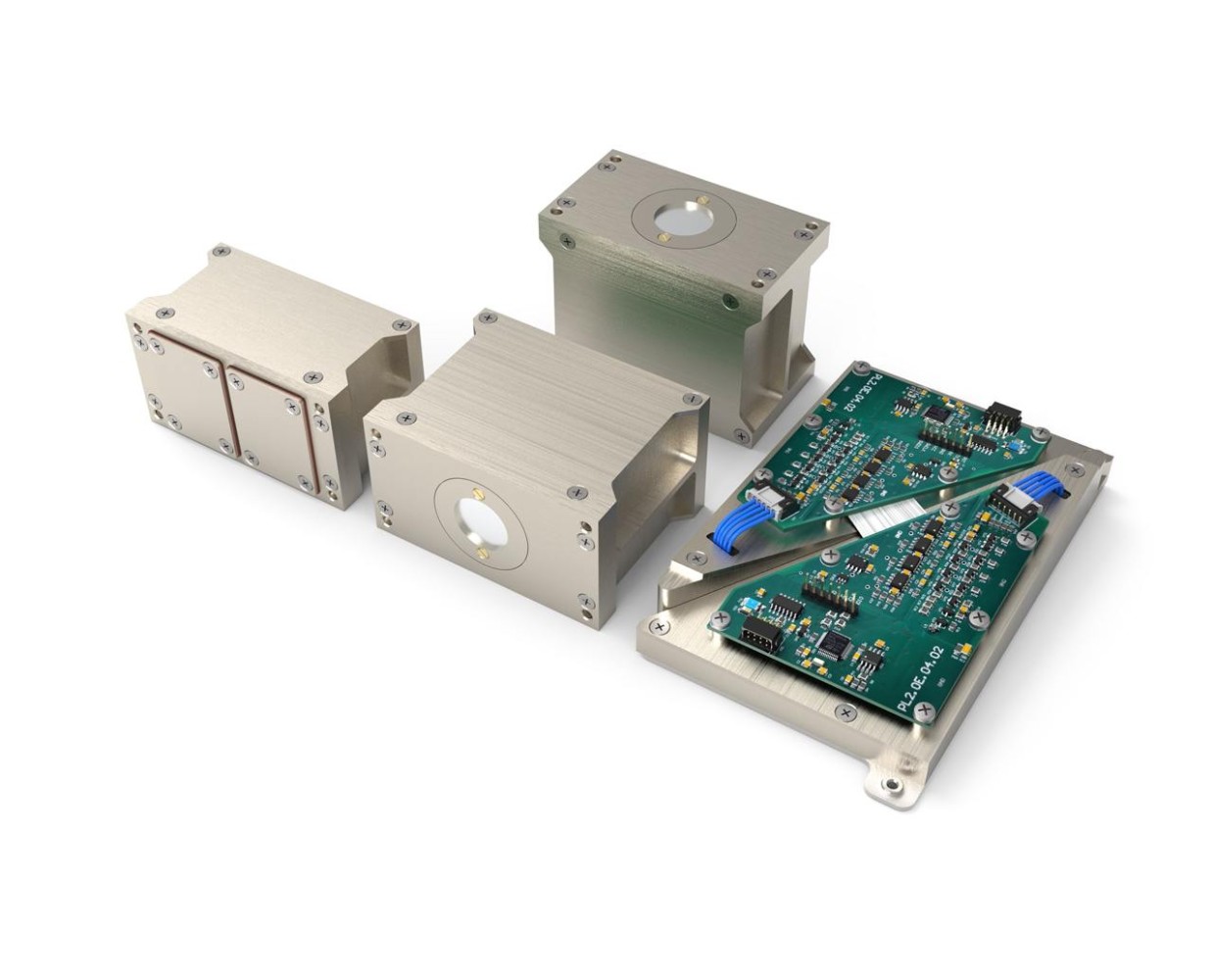
PL-1 variants fit different accommodation constraints, including general CubeSat structures and Tuna Can volume. PL-1m adds directional capability at roughly 5 degrees per pixel. PL-2 provides omnidirectional detection of relativistic particles using Cherenkov crystals and silicon photomultipliers. The default set combines two PL-1 units with one PL-2, giving coverage across a much wider energy span than operators usually get from a small hosted payload.
The operational logic is equally important.
We are not treating the instrument as an isolated science box. The architecture is explicitly built around data flow, onboard buffering, configurable interfaces, mission-specific ICDs, and software updates in flight. In our white paper we describe a data stack from raw packet-derived products to calibrated fluxes and value-added operator products such as alerts, anomaly attribution indicators, drag nowcasts, and model-ready outputs. Operators do not need more disconnected payloads. They need measurements that move cleanly into decisions.
This is also why the absence of high-energy spectrometers has persisted for so long. It was never just a sensor problem. It was a systems problem.
To make these measurements useful, you need a package that survives LEO, fits the bus, produces manageable data volumes, supports flexible interfaces, can operate in persistent monitoring mode, and feeds products with low enough latency to matter.
The industry has better launch, better buses, better onboard compute, and more spacecraft in orbit than ever before. But the environmental sensing layer is still underbuilt relative to the value of the assets it is supposed to protect. Operators are already paying for that through drag uncertainty, missed context in anomaly investigation, conservative operating margins, and avoidable blind spots during disturbed conditions.
High-energy particle spectrometers were rare because physics made them hard, spacecraft budgets made them inconvenient, and the operational market was willing to accept less.
That is changing.
As commercial operators demand mission-specific forecasting, better fault attribution, better drag awareness, and better environmental intelligence, the old compromise starts to break. The market now needs instruments that are compact, affordable, and deployable at scale, but still capable of resolving the particle environment with enough fidelity to improve models and operations.