Mission Space sensors will fly across Starcloud’s orbital data-center constellation, dramatically expanding the in-situ data available for space environment monitoring, forecasting, and warnings.
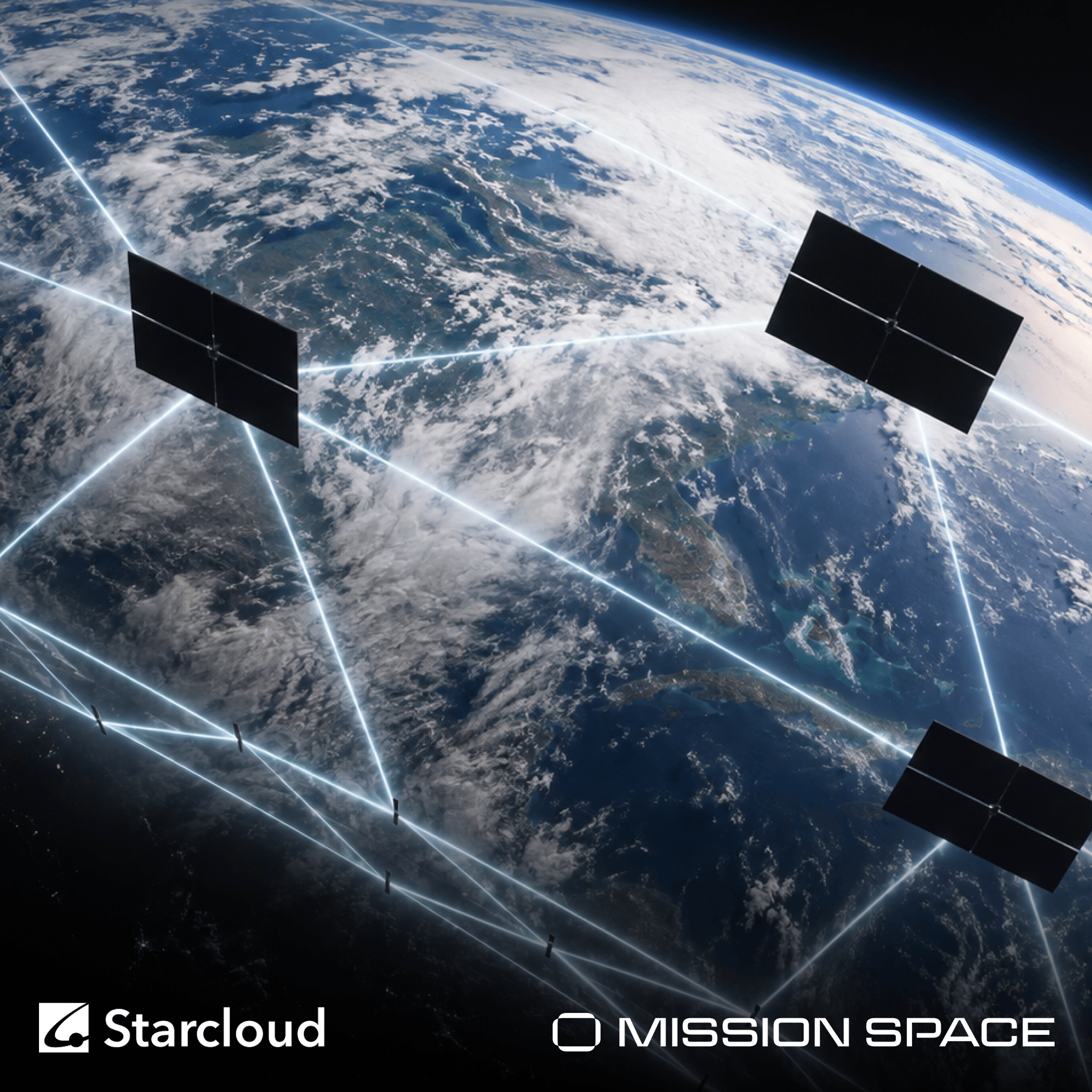
Mission Space and Starcloud have signed a Letter of Intent to deploy Mission Space sensors across Starcloud’s orbital data-center constellation, laying the foundation for the largest distributed in-situ space environment monitoring network in low Earth orbit.
The first Mission Space sensor will fly aboard a Starcloud spacecraft in 2027. Following this mission, Starcloud intends to make one Mission Space sensor set standard equipment on every spacecraft it deploys in the constellation. Starcloud has filed an FCC application for a constellation of up to 88,000 satellites.
The network will continuously measure space environment conditions across LEO, feeding Mission Space models with in-situ data from thousands of orbital locations. Mission Space will use these measurements to track radiation events as they develop, forecast conditions along spacecraft trajectories, and issue warnings to satellite operators and crewed missions before hazardous conditions reach their assets or crews.
For government and commercial operators, the output is operational: where the risk is, which assets are exposed, how severe it is expected to be, and when action is required. The data will power radiation maps, mission-specific forecasts and alerts used for safe-mode decisions, anomaly attribution, mission planning and crew radiation risk management.
“Spacecraft operators need to know what is happening around their assets and what is coming next,” said Mary Glaz, CEO and co-founder of Mission Space. “With sensors distributed across LEO, we can track the environment across multiple locations, feed those measurements directly into our models real-time and warn operators when their spacecraft or crews are approaching hazardous conditions. This is the measurement density required to make space-weather warnings mission-specific.”
For Starcloud, Mission Space sensors will provide continuous measurements of the radiation environment around its orbital computing infrastructure. High-density compute hardware in LEO is exposed to total ionizing dose, single-event effects and rapid changes in radiation conditions caused by solar energetic particle events and geomagnetic storms. Mission Space will provide spacecraft-local measurements, nowcasts, forecasts and alerts suitable for automated ingestion into Starcloud fleet operations.
This information will allow Starcloud to incorporate the radiation environment into fleet operations, including workload scheduling, accumulated radiation exposure and response to elevated radiation conditions.