Solar storms have been treated as an infrastructure risk for decades, but most economic analysis still reflects an economy in which the principal exposed assets were power grids, aviation, communications and navigation systems on Earth.
The historical record used to estimate solar-storm losses was built before most of this infrastructure existed. Halloween 2003 remains the standard modern reference for many space-weather scenarios. The two events that provide direct evidence for today’s orbital economy — the May 2024 Gannon storm and the January 2026 radiation storm — occurred under a very different exposure base and affected it through different physical mechanisms.
Our new research, Solar Storms and the Space Economy, looks at what that means economically. We developed the Solar Storm Economic Exposure Model (SSEEM) v2.0 to estimate losses across nine economic channels and five severity tiers, from power grids and GNSS-dependent industries to satellite infrastructure, orbital compute, human spaceflight and lunar operations.
The central estimate is $20.6 billion in annualised global economic loss in 2026. Under the exposure-growth assumptions examined in the research, that reaches $44.3 billion by 2035.
The composition changes more sharply than the total. Orbital and beyond-Earth systems account for 17% of expected loss today and 42% by 2035. The model holds solar-storm frequencies constant between the two years. The increase comes from the infrastructure being deployed.
The May 2024 Gannon storm was the first G5 geomagnetic storm of the modern constellation era.
Thermospheric density at 400 km reached roughly six times its pre-storm level. About half of approximately 10,000 active LEO payloads manoeuvred, orbital decay rates reached 180 metres per day, and conjunction assessment became very difficult or impossible during the storm and for days afterwards.
The economic effects extended well beyond spacecraft. Ionospheric disturbance produced GPS positioning errors of up to 70 metres across the central United States for roughly six hours during the planting window, contributing to estimated losses of more than $500 million for Midwest agriculture. ICAO issued 148 advisories.
January 2026 produced a different event. An X1.9 flare was followed by an S4 severe radiation storm, among the most intense in the GOES record, while the associated geomagnetic disturbance reached G4. By then roughly 16,000 satellites were in orbit and commercial computing hardware was already operating in LEO.
Geomagnetic heating expands the thermosphere, changing atmospheric density, drag and orbit prediction in LEO. Energetic particles cause single-event upsets, latch-ups and cumulative degradation in electronics. Surface and internal charging create another class of spacecraft failure. Beyond the magnetosphere, particle flux becomes a direct crew-dose constraint. On Earth, rapidly changing magnetic fields drive geomagnetically induced currents through long conductors and can destabilise power networks.
The economic consequences therefore depend on which infrastructure is exposed and which component of the space environment is driving the event.
Our model uses the hazard–vulnerability–exposure–financial structure of catastrophe modelling and separates the economy into nine channels: space infrastructure and connectivity; orbital compute and manufacturing; human spaceflight and commercial stations; space defence and national security; lunar and cislunar activity; Mars and deep space; power grids and the cascading macroeconomy; the GNSS-dependent ground economy; and aviation.
For 2026, central annualised expected loss across those channels is $20.65 billion.
Power grids remain the largest individual exposure at $12.88 billion, or 62.4% of the total. The GNSS-dependent ground economy follows at $3.23 billion. Space infrastructure and connectivity contributes $2.21 billion, aviation $1.07 billion and space defence $0.92 billion.
One result is particularly relevant to how satellite risk is usually discussed: modeled losses to the GNSS-dependent ground economy are already larger than direct losses to space infrastructure.
The May 2024 agricultural losses illustrate why. A satellite does not have to fail for the economic service built on it to fail. Disturbed ionospheric conditions can degrade positioning while the spacecraft continues operating normally.
The same dependency extends through financial timing, telecommunications synchronisation, logistics, surveying, offshore operations and directional drilling. The economic exposure is determined by what society does with the signal, rather than by the replacement cost of the spacecraft producing it.
Total annualised expected loss reaches $44.27 billion. Power grids remain the largest channel at $18.03 billion, but space infrastructure and connectivity rises to $8.83 billion, becoming the second largest. The GNSS-dependent ground economy reaches $6.46 billion, space defence $4.59 billion and orbital compute and manufacturing $3.26 billion.
Taken together, orbital and beyond-Earth channels move from 17% to 42% of total expected loss.
This result does not assume a more active Sun. Hazard frequencies remain identical in the 2026 and 2035 calculations.
What changes is exposure: more satellites, more computing capacity in orbit, more crewed infrastructure and substantially more capital deployed in cislunar space and on the lunar surface.
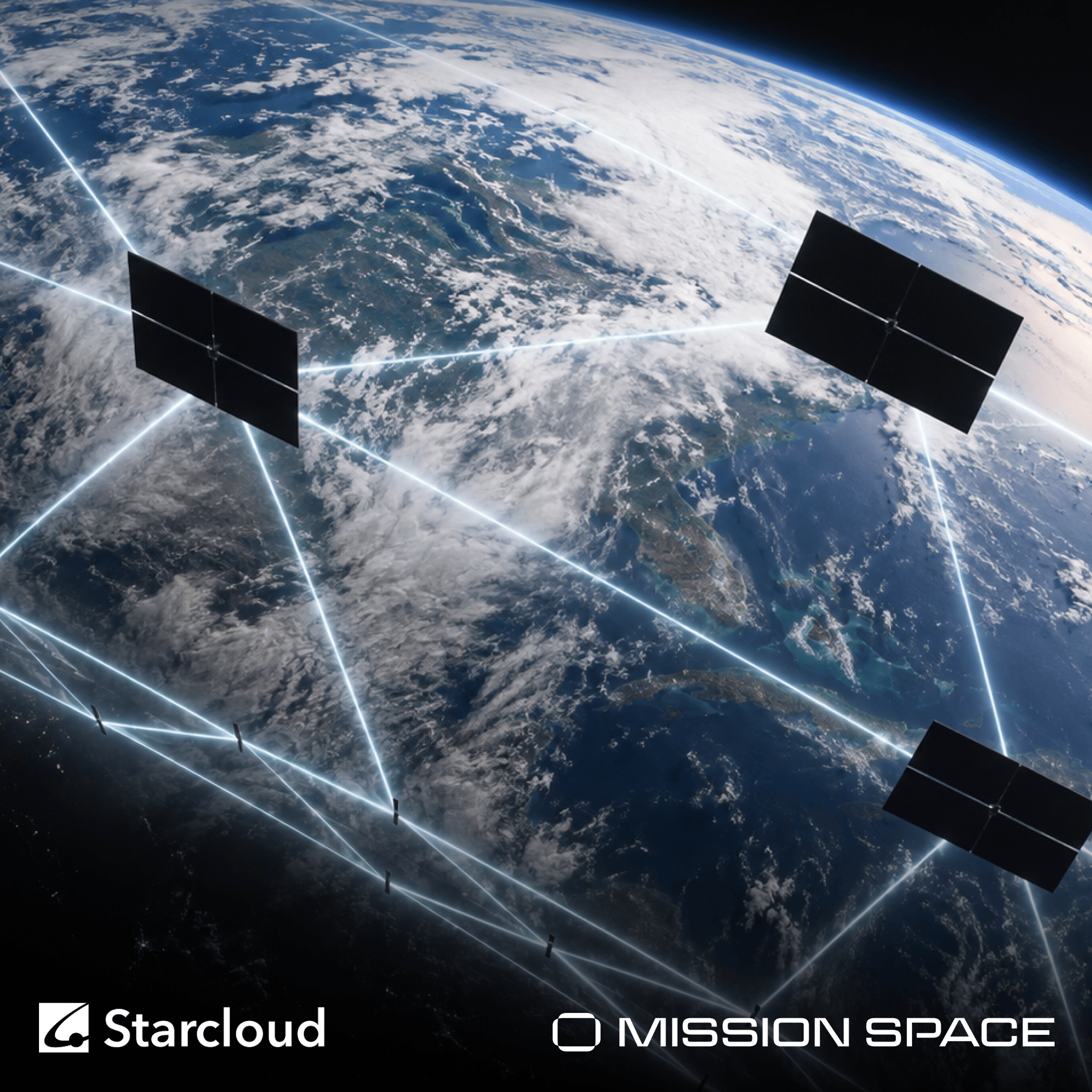
The individual sectors also grow at very different rates. SSEEM applies a 4× exposure multiple to space infrastructure and connectivity, 6× to human spaceflight and commercial stations, 8× to Mars and deep space, 12× to lunar and cislunar infrastructure, and 25× to orbital compute and manufacturing from its small 2026 base.
Data-centre resilience depends heavily on redundancy, workload replication, checkpointing and failover between nodes. In orbit, a severe particle event creates a common environmental exposure across hardware occupying the same region.
Single-event upset rates can increase across processors and memory simultaneously. Latch-up can affect power electronics. Radiation-induced errors can occur across multiple nominally redundant nodes during the same event.
That changes the architecture required for redundancy. Physical separation of computing capacity, radiation tolerance, error correction, checkpoint frequency and recovery across different orbital locations all become part of system availability.
The economic exposure remains relatively small today because orbital compute itself is still small. SSEEM estimates approximately $130 million in annualised expected loss in 2026. Under the 2035 exposure case, that reaches approximately $3.3 billion, exceeding the modeled exposure of aviation.
Conjunction assessment depends on sufficiently accurate predictions of where objects will be. During a geomagnetic storm, thermospheric density can change rapidly across a large part of LEO. Drag changes simultaneously across thousands of objects, causing their trajectories to diverge from pre-storm predictions.
Operators then begin manoeuvring spacecraft in response to the same event.
The result is a coupled problem: environmental changes reduce the accuracy of predicted trajectories while operational responses introduce additional trajectory changes into the catalogue.
In May 2024, conjunction assessment became very difficult or impossible during the storm and remained impaired for days.
With a growing orbital population, storm-time atmospheric-density forecasting therefore becomes part of collision-risk management. The same applies to coordination of manoeuvres when many operators are responding to the same environmental disturbance.
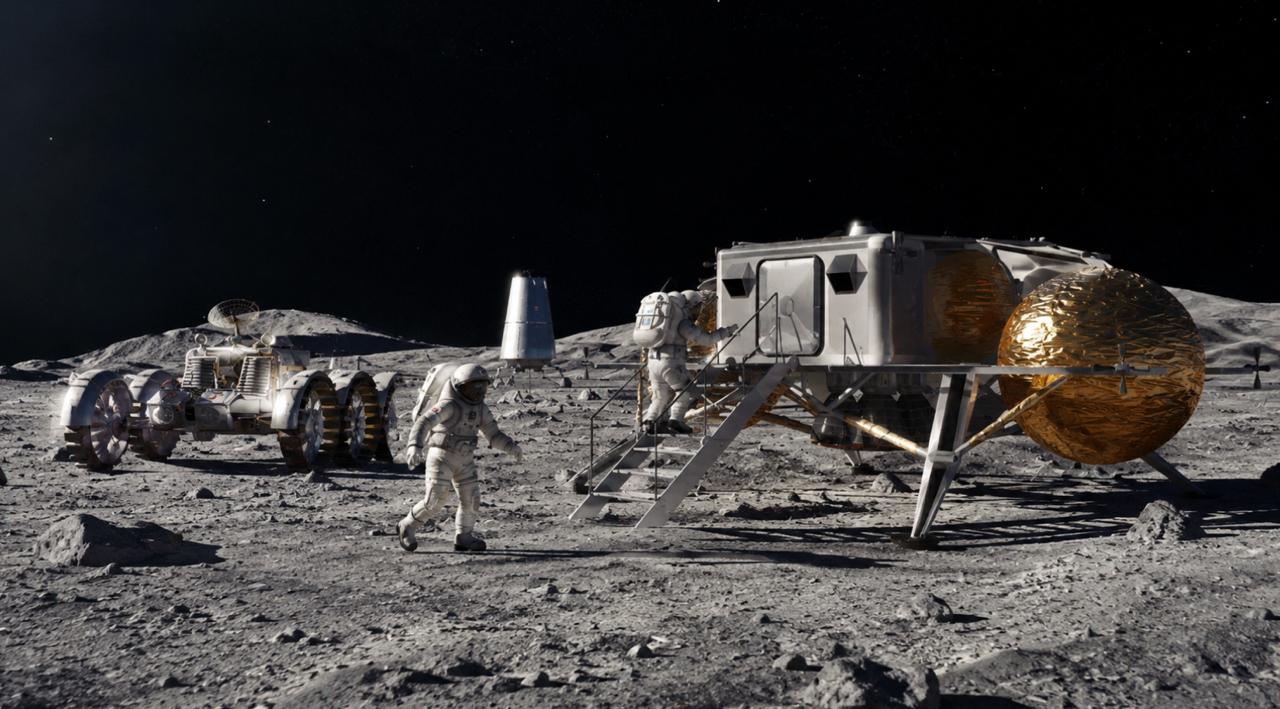
Outside Earth’s magnetosphere, solar energetic particles directly affect crew dose, electronics and surface operations. Galactic cosmic rays provide a persistent background exposure. Surface charging and charged dust add environmental effects specific to lunar operations.
The August 1972 solar particle event provides the historical reference. It occurred between Apollo 16 and Apollo 17. Estimated unshielded exposure on the lunar surface would have exceeded 10 Gy to the skin and approximately 2 Gy to bone marrow — sufficient to produce acute radiation syndrome and potentially lethal consequences during an EVA.
For sustained operations, frequency matters alongside severity.
A lunar programme operating continuously across multiple crews will therefore encounter severe radiation conditions during its operating life. EVA schedules, shelter access, surface transportation, communications, power operations and local environmental measurements have to account for those interruptions.
This is why SSEEM’s lunar and cislunar exposure grows twelvefold between 2026 and 2035 as the underlying economic activity moves from individual missions toward sustained infrastructure.
The distribution of expected loss is heavily concentrated in extreme events.
In SSEEM, 77% of annualised expected loss comes from the Carrington-class tier. T1 through T3 storms account for 17%. Those lower tiers represent essentially the entire operational experience of people currently managing grids, satellites, aviation and space-weather operations.
Many companies operating today’s orbital infrastructure have existed for less than one solar cycle.
The frequency of the extreme tail also remains economically consequential. Published estimates of Carrington-class recurrence range from approximately 0.46% to 12% per decade. SSEEM uses the Lloyd’s/AER 1-in-150-year recurrence in the central case. Moving across published recurrence estimates changes annualised expected loss from about $7.0 billion to $35.3 billion without changing severity.
There is also new evidence concerning how severe the upper tail could become. Research published in Nature in July 2026 found that the apparent saturation of Earth’s geomagnetic response under extreme solar-wind driving can be explained by measurement uncertainty. The authors estimate that extreme geomagnetic impacts may be approximately twice previous estimates.
SSEEM carries this as a separate sensitivity case. Applying a 2× multiplier to the upper severity tiers takes the modeled Carrington-class loss from approximately $2.4 trillion to $4.8 trillion and annualised expected loss from $20.6 billion to $37.8 billion.
Space weather is also unusual economically because the same physical event can generate losses across sectors that are normally modelled separately.
The March 1989 storm caused the Hydro-Québec blackout, permanent transformer damage in New Jersey, more than 250 anomalies on NASA’s TDRS-1, interruption of GOES communications, a spurious Space Shuttle sensor reading and loss of HF communications for Australian forces in Namibia. In a related event that year, three redundant disk drives failed and halted trading on the Toronto Stock Exchange.
May 2024 produced a modern version across orbital operations, GNSS, agriculture and aviation.
This correlation matters for insurance and reinsurance because economic losses frequently occur without physical destruction of an asset. Additional propellant consumption, reduced mission life, degraded positioning, service interruption, flight rerouting, compute downtime and operational stand-down can all produce losses from the same solar event.
As the orbital economy grows, those exposures increasingly sit alongside the established terrestrial ones.
By 2035, SSEEM places space infrastructure and connectivity behind only power grids among the nine modeled channels. Orbital compute exceeds aviation. Defence exposure increases fivefold under the development assumptions, while lunar and cislunar exposure increases twelvefold.
Those changes translate into specific requirements for the systems now being designed: radiation-aware architecture for orbital computing; storm-time density forecasting and manoeuvre coordination for large constellations; radiation sheltering and local particle measurements for lunar operations; resilient positioning and timing for terrestrial industries; and risk-transfer structures capable of accounting for correlated losses across sectors.
Solar Storms and the Space Economy publishes the complete SSEEM v2.0 methodology with the research: nine economic channels, five severity tiers, all 45 tier-channel cells, their source basis and confidence grades, the 2035 exposure assumptions and the sensitivity analysis.