Radiation environments on the Moon and Mars are often discussed as if they differ only in intensity, but the structure of the dose is different. On the Moon, measurements from the LRO CRaTER instrument show an average dose of about 1.3–1.5 mSv per day during quiet solar conditions. The Chang’e-4 lander measured similar surface values in Von Kármán crater. This is a mix of galactic cosmic rays plus occasional solar energetic particle spikes.
On Mars, Curiosity’s RAD instrument recorded around 0.65–0.75 mSv per day on the surface, and about 1.8 mSv per day during the cruise phase. The Martian atmosphere reduces part of the flux but produces secondary neutrons that contribute significantly to biological dose.
So the Moon is a clean, mostly unmoderated field. Mars has less raw intensity but more neutron-driven complexity.
To understand this environment correctly, what matters is the shape of the particle spectrum, not just the total dose. GCRs arrive as high-energy heavy ions like Fe and O near relativistic speeds. When these hit lunar regolith, they produce neutron showers.
On Mars, primary particles collide in the thin CO₂ atmosphere first, generating neutrons that then reach the surface. This is why neutron dosimetry is mandatory for Mars surface planning and only situational on the Moon. Shielding strategies diverge because the dominant secondaries differ: hydrogen-rich materials (water, polyethylene) suppress neutrons better than regolith alone. This directly influences habitat material choices and layout.
Measurement approach reflects this. In orbit, detectors see an averaged spectrum dominated by particle flux from all directions. On the surface, half the sky is blocked by the local horizon. This lowers dose but also makes the environment strongly location-dependent.
A habitat at the floor of a steep crater may receive up to 30–40 percent less GCR flux than one on a ridge line. A habitat near a boulder field or lava tube entrance may see altered secondary neutron fields. These effects cannot be inferred from orbit. They require local gradient mapping across tens to hundreds of meters.
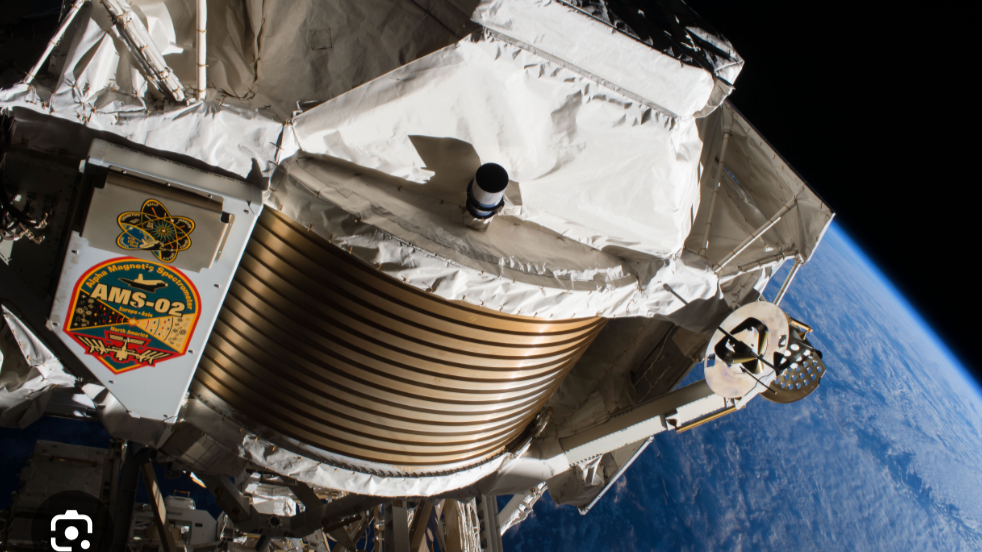
This is where in-situ payloads matter. A standard surface radiation package is not one detector but a stack: silicon telescope to resolve LET (linear energy transfer) spectra; Cherenkov or scintillator detectors for high-energy flux; a neutron spectrometer for moderation signatures; and a tissue-equivalent dosimeter for biological-weighted dose.
On Mars, adding atmospheric pressure and dust optical depth sensors links radiation variations to weather patterns. On the Moon, adding surface-charge and electrostatic field sensors links radiation spikes to regolith charging, which affects mobility and habitat operations.
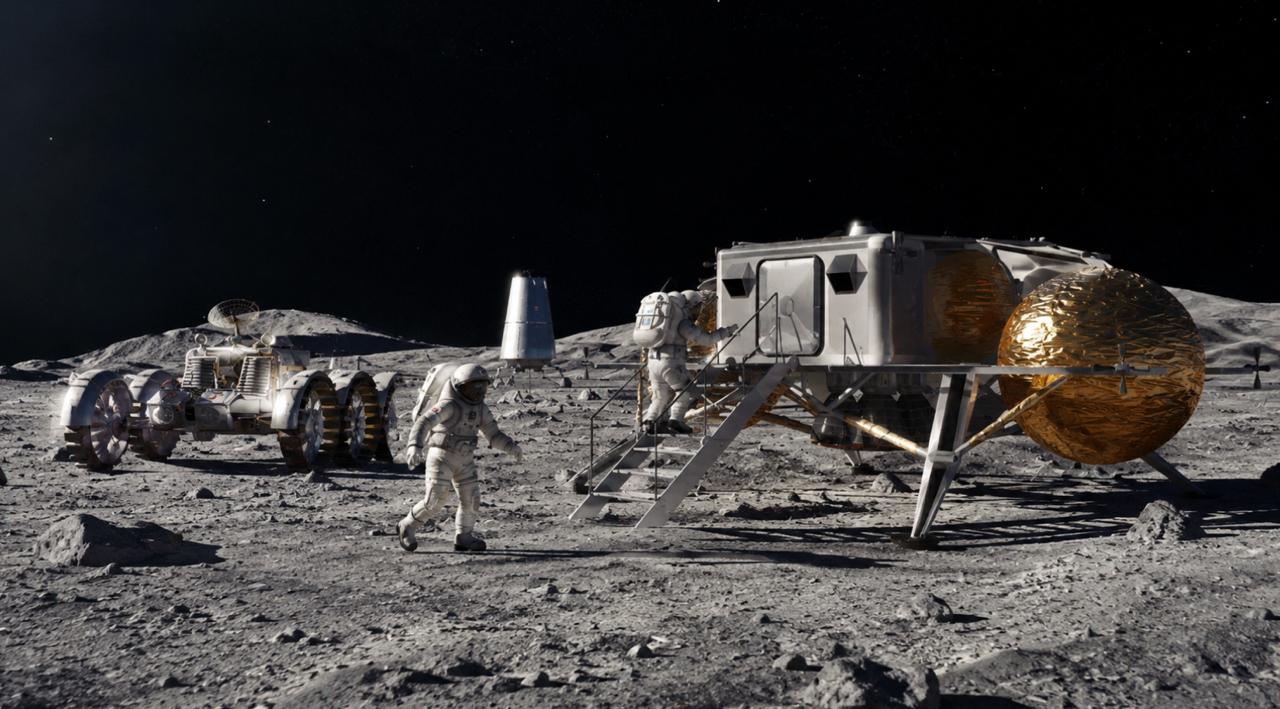
In-situ data changes planning. Instead of assuming uniform exposure and burying everything under 7–10 meters, surface measurements allow selective shielding: use topography to reduce GCR baseline, add hydrogen-rich layers only where secondaries peak, and use early solar storm precursors to schedule crew sheltering rather than relying on permanent overbuild.
This shifts radiation protection from brute-force construction to site selection, materials selection, and forecasting. It reduces mass, complexity, and failure points — and makes surface presence scalable rather than one-off demonstration.
Surface radiation cannot be generalized across bodies. The Moon requires managing direct high-energy particle flux and reducing secondary production in regolith. Mars requires moderating neutron fields created in the atmosphere and soil. These environments call for different shielding materials, different placement of habitats, and different monitoring systems. Accurate planning depends on local in-situ measurements of particle spectra and temporal variation, not assumptions transferred from orbit or from one world to another.