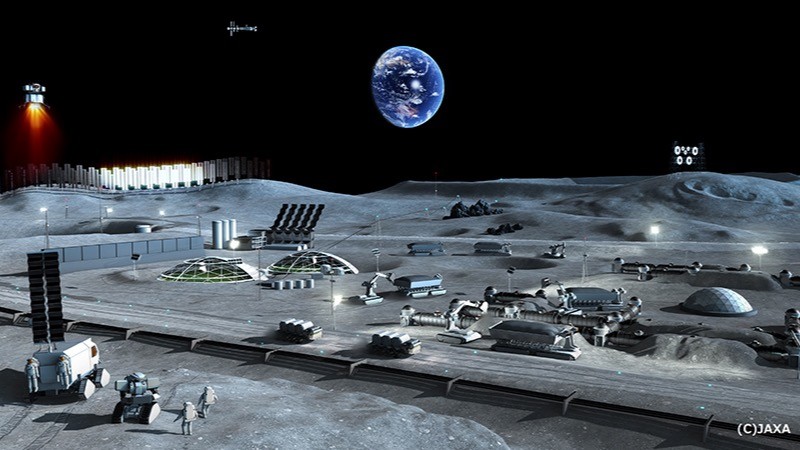
The lunar south pole is being treated as the next operating region for human and robotic missions because it combines scientific targets, possible volatiles, and terrain with long-duration illumination. The same geography also makes it one of the harder places to operate hardware.
The Sun stays low on the horizon. Crater rims, slopes, and permanently shadowed regions create sharp temperature and illumination gradients. A rover can move from direct solar exposure into deep shadow over short distances. A lander, solar array, radiator, antenna, cable, or dust-sensitive optical surface can sit inside a very different electrical and thermal environment than another asset a few hundred meters away.
That is why lunar space weather cannot be treated as a remote forecast product alone. The relevant measurements have to be local.
On Earth, space-weather monitoring benefits from a dense atmosphere, a global magnetic field, ground observatories, satellite networks, ionosondes, magnetometers, GNSS receivers, and operational centers. The Moon has none of that infrastructure. It has no dense atmosphere and no global magnetic field. Solar wind plasma, ultraviolet radiation, solar energetic particles, galactic cosmic rays, micrometeoroid impacts, and charged dust interact directly with the regolith and exposed hardware and crews.

The south pole needs environmental monitoring stations on the surface and instrumented orbiters above it. Surface stations measure the conditions around actual assets. Orbiters provide regional context, upstream particle and plasma measurements, coverage across the polar terrain, and cross-calibration between sites.
NASA’s recent payload selections show the same direction. DUSTER (DUst and plaSma environmenT survEyoR), selected for Artemis IV, will characterize dust and plasma around the lunar south pole landing site. Its Electrostatic Dust Analyzer will measure dust charge, velocity, size, and flux, while RESOLVE will characterize average electron density above the surface using plasma sounding. NASA describes the payload as a way to understand the natural dust and plasma environment and how it responds to crew activity and lander liftoff.
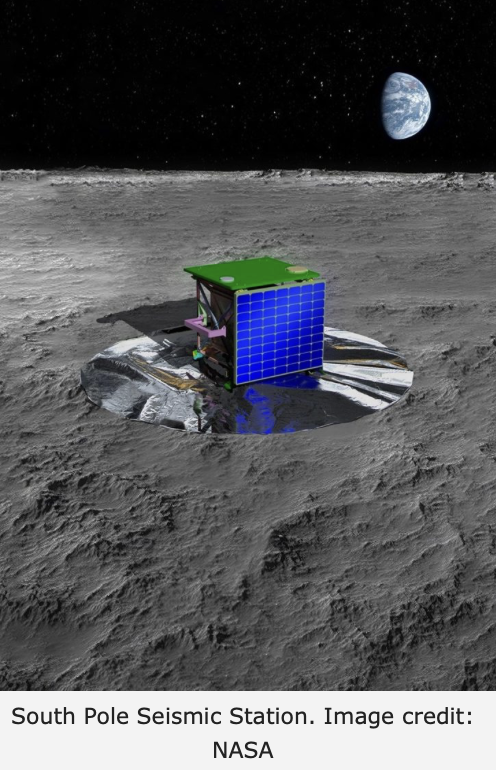
NASA also selected the South Pole Seismic Station for Artemis IV to monitor the real-time seismic environment and meteorite impacts, and SELINE in 2026 to study the lunar surface radiation environment, including primary galactic cosmic rays, secondary particles, and interactions with the regolith
These are separate instruments, but the technical problem is coupled. Radiation changes electronics and dose. Plasma drives charging. Charging affects dust. Dust affects radiators, optics, mechanisms, seals, solar panels, and thermal control surfaces. Thermal gradients and illumination change the surface potential. Micrometeoroid impacts produce ejecta and local disturbances. A useful monitoring system has to measure these interactions together.
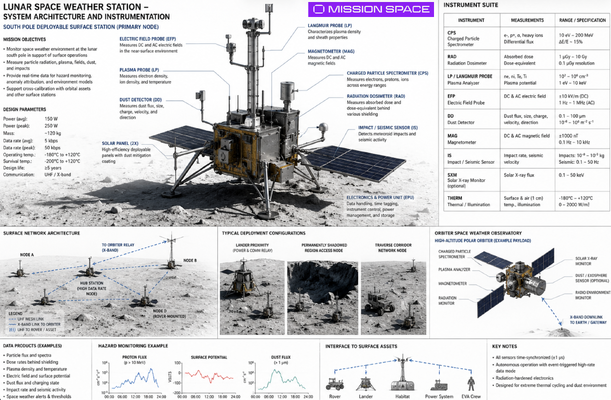
A south pole surface station should begin with charged-particle measurements. The basic instrument is a compact charged-particle spectrometer that measures electrons, protons, alpha particles, and heavier ions where possible. The measurement should include differential and integral flux across energy bands, not only total count rate.
The lunar surface receives several different radiation populations. Galactic cosmic rays provide a persistent high-energy background. Solar energetic particle events can raise proton flux quickly. Secondary particles are generated when high-energy particles interact with regolith, lander structures, shielding, and habitat materials. A simple dosimeter can show accumulated dose, but it cannot identify the particle population driving the event.
For operations, the useful data product is time-resolved flux by species and energy band. A rover operator needs to know whether the event is a low-energy electron enhancement relevant to charging, a proton event relevant to dose and electronics, or a high-energy particle environment that affects shielding assumptions. A payload engineer needs to correlate resets, noise, latch-up events, or detector saturation with the measured particle spectrum.
A radiation dosimeter should sit next to the spectrometer but serve a different function. It should measure absorbed dose and dose-equivalent behind defined shielding thicknesses. One dosimeter should be exposed. Others should sit behind representative shielding: aluminum, composite panels, electronics boxes, rover body structures, or habitat wall analogs. That converts the external particle environment into hardware-relevant exposure.
The surface station also needs plasma measurements. A Langmuir probe, plasma impedance probe, or equivalent instrument can measure electron density, ion density, electron temperature, and local plasma variability. DUSTER’s RESOLVE instrument is designed around this need: measuring electron density above the surface using plasma sounding.
This measurement is essential because the lunar surface charges through several mechanisms at once. Solar UV produces photoelectrons. Solar wind plasma delivers ions and electrons. Shadowed surfaces behave differently from illuminated surfaces. The near-surface plasma sheath changes with solar wind conditions, local topography, and activity around the lander or rover. Around the terminator and near permanently shadowed regions, those effects can change over short distances.
Surface charging cannot be inferred cleanly from solar wind data alone. A local station has to measure electric field, surface potential, and plasma density together. Electric-field probes should sit at more than one height above the regolith. Surface-potential sensors should be placed near conductive structures and exposed surfaces: lander legs, rover wheels, cable runs, antennas, solar array mounts, radiator panels, and dust-sensitive optical systems.
Dust measurement is the third part of the same package. The relevant dust instrument should measure particle flux, size, charge, velocity, and direction. DUSTER’s Electrostatic Dust Analyzer targets exactly those variables.
Dust is not only a contamination problem after landing. It can be mobilized by plume effects, rover motion, electrostatic forces, impacts, and human activity. Dust adhesion changes with surface charge, material, texture, illumination, and temperature. The particles are abrasive and can degrade seals, bearings, radiator surfaces, optical windows, solar panels, connectors, and suit interfaces.
A station that measures dust without plasma and electric fields gives incomplete data. A station that measures plasma without dust also misses the operational outcome. The important question is whether changing plasma and charging conditions are producing more mobile dust near the hardware.
The placement of sensors matters as much as the sensors themselves.
Dust should be measured near the regolith, near rover or payload deck height, and near sensitive surfaces such as optics, radiators, and solar panels. A dust detector at ground level may record local saltation or plume-driven movement. A detector mounted higher can capture lofted particles that reach hardware surfaces. The difference between the two is operationally important.
Electric-field probes also need geometry. A single field measurement near the ground does not describe the potential structure around a rover, lander deck, cable harness, or solar array mast. Sensors should be mounted at multiple heights and, where possible, near different materials. Conductors, dielectrics, coated surfaces, solar array glass, thermal blankets, and exposed regolith will charge differently.
Thermal and illumination sensors need similar spatial coverage. The south pole’s low Sun angle creates terrain-driven illumination patterns. Local shadowing affects surface temperature, battery performance, radiator effectiveness, volatile stability, and charging. A station should measure regolith temperature at shallow depths, exposed surface temperature, hardware temperature, solar incidence, and shadow state.
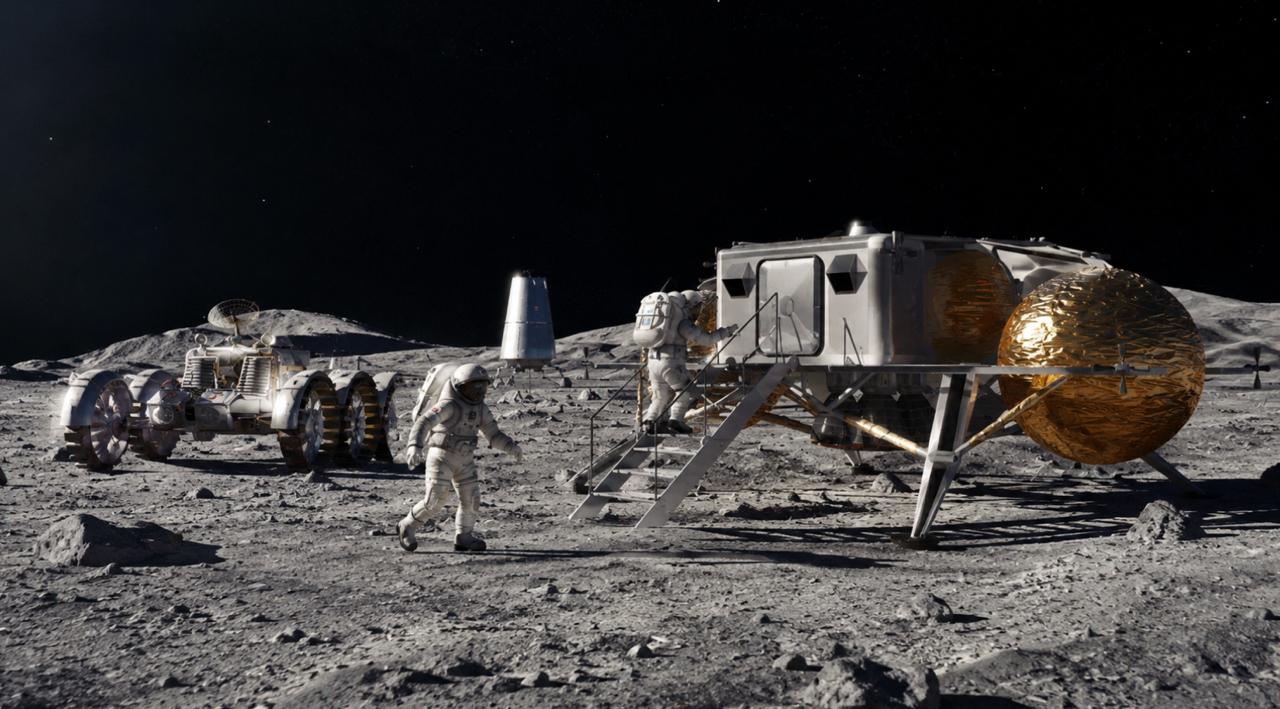
This is why one large station is less useful than several compact nodes. A lander zone, rover traverse corridor, crater rim, permanently shadowed region access point, solar array field, and communication tower may each need local environmental measurements. The south pole is not one environment. It is a set of adjacent microenvironments.
A magnetometer is required on both surface stations and orbiters. The Moon lacks a global dipole field, but it has localized crustal magnetic anomalies and moves through different plasma regimes during its orbit. Magnetic-field data is needed to interpret particle pitch-angle effects, plasma boundaries, induced fields, and changes linked to Earth’s magnetotail.
At the surface, a magnetometer helps separate local disturbances from external space-weather drivers. If plasma density, electric field, and dust flux change at the same time, magnetic-field context helps determine whether the driver is solar wind structure, magnetotail passage, local activity, or an instrument/hardware disturbance.
For orbiters, magnetometers are even more important. An orbital platform can measure regional fields, solar wind interaction, wake structure, crustal anomaly regions, and the transition between plasma environments. That orbital context helps interpret why two surface stations separated by terrain may see different electrical or particle conditions during the same event.
Surface stations provide asset-level truth. They cannot provide regional coverage.
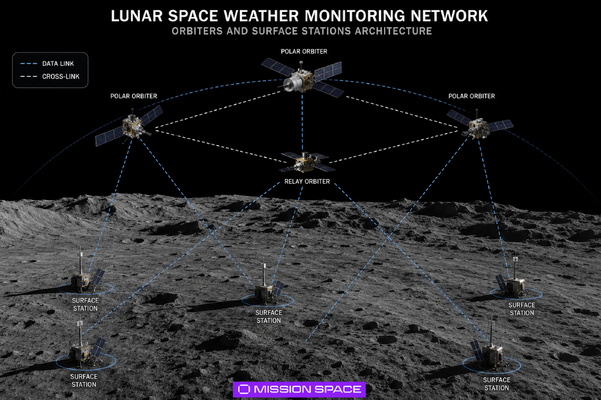
A lunar orbiter can map particle and plasma conditions over the south pole, connect measurements between multiple surface stations, and observe the environment above regions that are unreachable or blocked by terrain. This is especially important near permanently shadowed regions and cratered polar topography, where line-of-sight, illumination, and thermal conditions vary sharply.
An orbiter should carry at least:
The orbital measurement layer answers different questions from the surface layer. It can show whether a radiation enhancement is regional or local. It can detect solar energetic particle arrival before a specific surface node reaches threshold. It can map particle gradients across the polar region. It can compare illuminated and shadowed regions from above. It can support far-side or obstructed stations when direct Earth visibility is limited.
Gateway’s planned lunar orbit also reflects the value of this region for science and monitoring. NASA describes early Gateway science as focused heavily on radiation from the Sun and deep space, and ESA describes Gateway’s near-rectilinear halo orbit as a highly elliptical path that brings it close to the Moon and then far into deep space.
That type of orbit is useful because it samples different parts of the lunar and cislunar environment. A dedicated monitoring orbiter or hosted payload can provide both regional lunar context and a bridge between Earth-based space-weather observations and surface measurements.
A solar event does not appear at the lunar surface as one clean parameter.
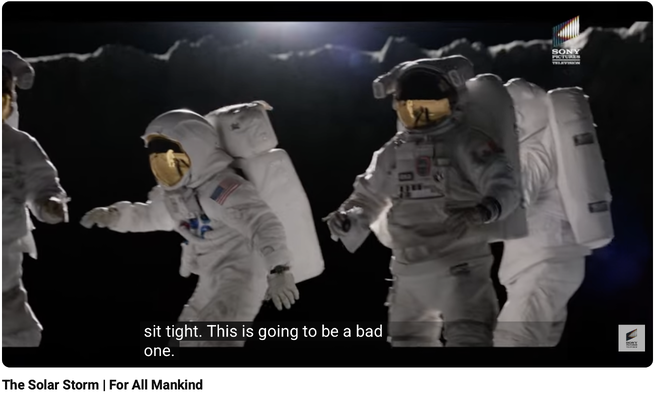
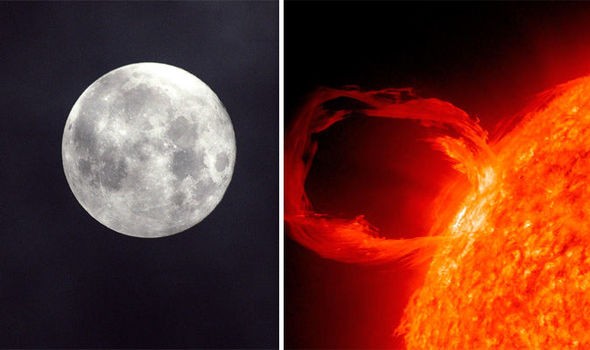
A flare changes X-ray and EUV flux. That can alter photoelectron production and surface charging. A CME-driven shock changes solar wind density, velocity, magnetic field, and plasma pressure. A solar energetic particle event raises radiation exposure and can affect electronics. Local charging changes can alter dust adhesion or dust motion. Dust can then affect optics, thermal surfaces, mechanisms, and solar arrays.
The measurement chain should therefore look like this:
Solar X-ray/EUV change → plasma and photoelectron response → surface potential and electric-field change → dust charging and dust motion → contamination or hardware exposure → operational threshold crossed
Or:
SEP event → proton/electron flux increase by energy band → dose rate increase behind shielding → electronics upset risk increase → EVA or surface activity constraint
Or:
Lander liftoff or landing plume → regolith disturbance → dust flux increase → charged dust transport → radiator or solar array contamination → thermal or power performance change
A station that measures only radiation misses the dust and charging chain. A station that measures only dust misses the plasma driver. A station that measures only surface potential misses the particle and field context. The lunar environment has to be measured as a coupled system.
The instruments should feed operational products. Raw plots are useful for scientists, but surface operations require thresholds.
Examples:
The key difference is location. A warning for the lunar surface should be tied to the asset: rover, lander, payload, solar array, cable, antenna, radiator, habitat module, or EVA route. The same solar event can have different consequences depending on shielding, material, illumination, terrain, and operational mode.
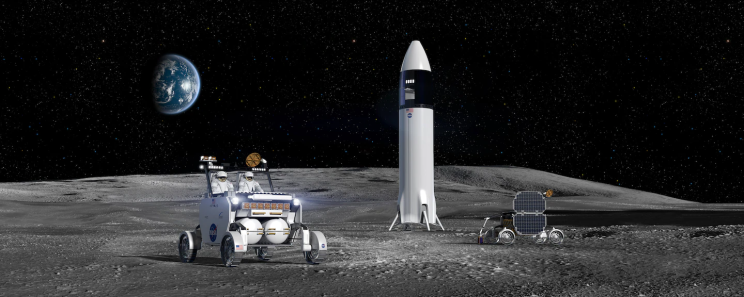
The engineering requirement is distributed sensing.
A practical south pole deployment would use fixed stations near landing sites, mobile sensors on rovers, compact payloads on landers, and orbital instruments above the region. Each surface node would carry a reduced but consistent measurement package: particles, dose, plasma, electric field, dust, magnetic field, thermal state, and illumination. Higher-capability nodes could add exosphere measurements, deeper thermal probes, seismic sensors, and more detailed plasma analyzers.
The network should support cross-calibration. If one station sees a charging event and another does not, the system can compare illumination, terrain, plasma density, magnetic field, and dust flux. If an orbiter sees a regional particle enhancement but only one surface station records increased dose behind shielding, the difference may come from local shielding geometry or station placement. If dust flux rises after a rover pass without a corresponding plasma change, the driver is likely mechanical activity rather than electrostatic lofting.
This is the technical value of combining orbiters and stations: the system can identify drivers, propagation, and local effects.
The Moon’s south pole will not be operated safely through broad space-weather awareness alone. It needs direct measurements at the surface, regional measurements from orbit, and software that converts both into hardware-specific warnings.