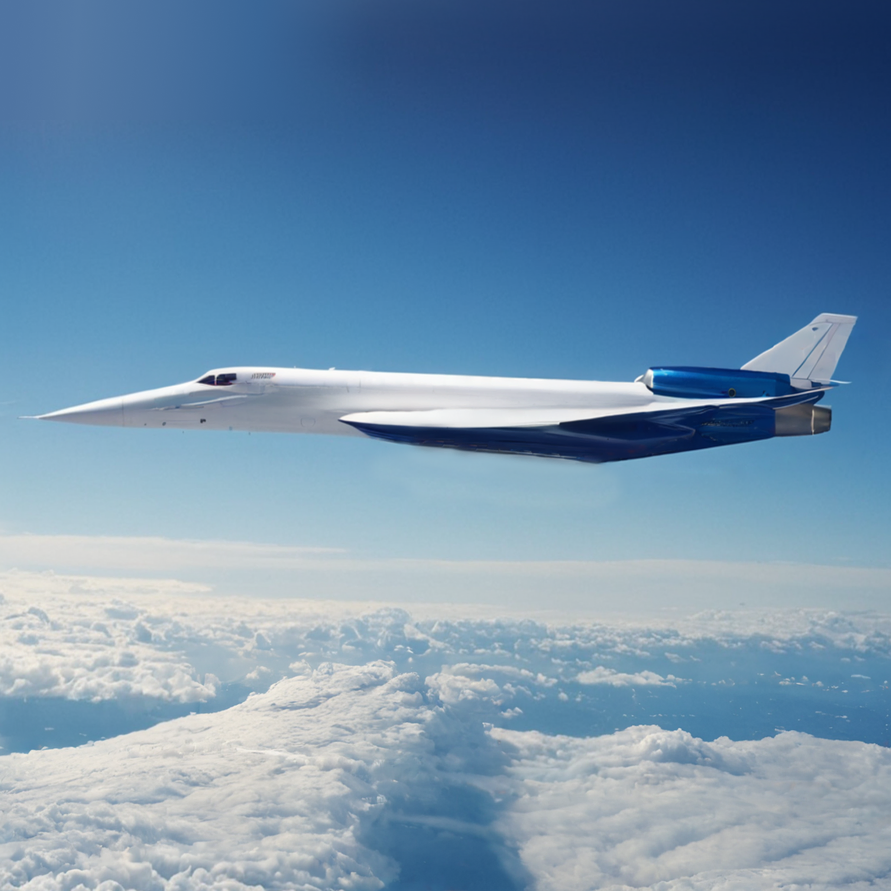
As commercial supersonic travel makes a comeback, space weather will play a critical role in shaping the safety and efficiency of these high-altitude flights. While the industry focuses on aerodynamics, propulsion, and noise reduction, space weather effects—radiation exposure, communication disruptions, and navigation challenges—demand equal attention.
Unlike conventional airliners cruising between 30,000 and 40,000 feet, supersonic aircraft like Boom Supersonic’s Overture are designed to fly at approximately 50,000 feet. At these altitudes, aircraft encounter a different atmospheric and space weather environment, making them more susceptible to solar storms and cosmic radiation.
With Boom’s XB-1 demonstrator breaking the sound barrier in early 2025, progress toward commercial supersonic travel is accelerating. However, ensuring flight safety requires addressing the unique risks posed by space weather.
Radiation exposure increases with altitude, and at 50,000 feet, the radiation flux is roughly 300 times higher than at sea level. While passengers on individual flights may not experience harmful doses, crew members on regular supersonic routes could face long-term health risks. The problem intensifies during solar storms, when high-energy particles from the Sun can spike radiation levels significantly, especially along polar routes where exposure is highest.
To mitigate these risks, real-time space weather monitoring is crucial. In extreme cases, aircraft may need to descend to lower altitudes to reduce radiation exposure—an operational challenge requiring careful coordination with air traffic control.
High-frequency (HF) radio communication, essential for transoceanic flights, is vulnerable to solar flares. Ionospheric disturbances can cause blackouts lasting from minutes to hours, compromising pilot-to-ground communication. A historical example occurred in 2015, when a solar flare disrupted aviation radar systems over Europe, forcing temporary airspace closures.
Navigation systems also suffer during geomagnetic storms, affecting the accuracy of satellite-based positioning. Supersonic aircraft, which rely on precise navigation across vast oceanic distances, must have backup systems such as inertial navigation and alternative communication methods like SatCom.
1. Altitude Adjustments – In response to space weather alerts, aircraft may need to temporarily descend below 49,000 feet to mitigate radiation exposure. This requires proactive coordination with air traffic control to avoid conflicts with subsonic aircraft.
2. Route Modifications – Supersonic jets are expected to use polar routes for efficiency, but these paths experience stronger space weather effects. Airlines may need to reroute flights during severe solar activity, impacting fuel efficiency and scheduling.
3. Redundant Communication Systems – To address HF blackouts, supersonic operators must integrate alternative communication methods like Controller-Pilot Data Link Communications (CPDLC) and satellite-based systems to ensure continuous connectivity.
For companies like Boom Supersonic, integrating space weather forecasting into flight planning is non-negotiable. Solar activity monitoring centers provide real-time alerts and predictive models, allowing operators to adjust flight plans accordingly. Improved forecasting capabilities will be essential as supersonic travel expands.
Future supersonic aircraft may incorporate radiation shielding or onboard monitoring systems to measure exposure in real time. Additionally, the need for precise altitude control to maintain "boomless cruise" technology—where supersonic aircraft minimize ground-level sonic booms—means space weather-driven altitude changes could impact noise compliance over land.
Space weather introduces a complex set of challenges for the next generation of supersonic travel. Increased radiation exposure, communication blackouts, and navigation disruptions require a proactive approach from aircraft manufacturers and operators alike.
By integrating advanced forecasting, operational protocols, and resilient communication systems, supersonic aviation can navigate these challenges and unlock the full potential of high-speed air travel.